

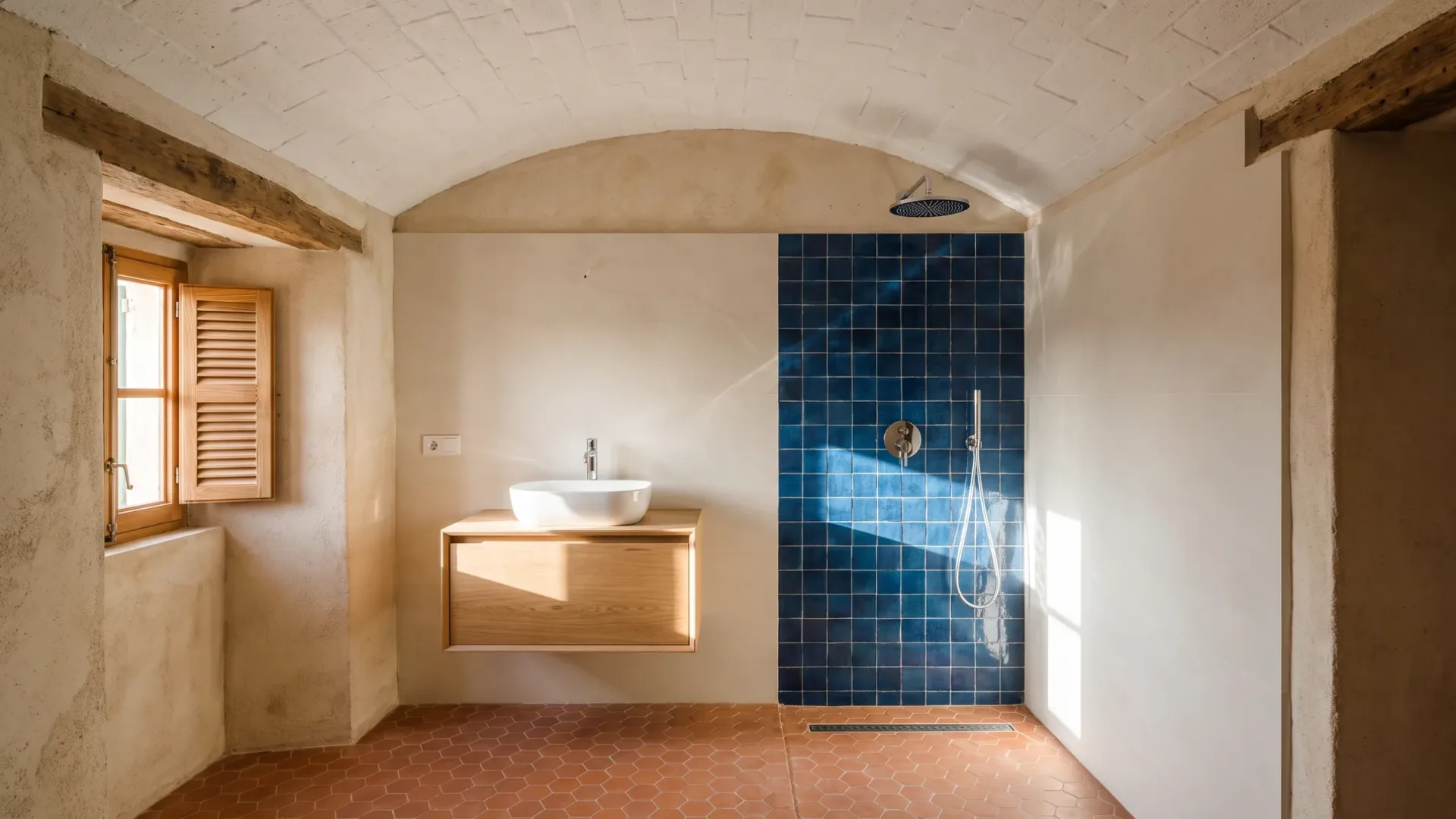
Bathroom Tiling and Surfaces in Mallorca
The surfaces are the bathroom you see, and the choice between them is a design decision, a budget decision and a technical one at the same time. A large-format porcelain wall, a natural stone floor and a microcement shower are three different jobs for the wall behind them and for whoever lays them. Describe the room and the look you want, and we pass the request to bathroom renovation companies near you.
request describes the job
companies see it
for you, always
obligation to accept
Choose your bathroom surface
Six materials, what each is good at, and what each asks of the room.
Porcelain
Ceramic
Large-format porcelain
Natural stone
Marble
Microcement
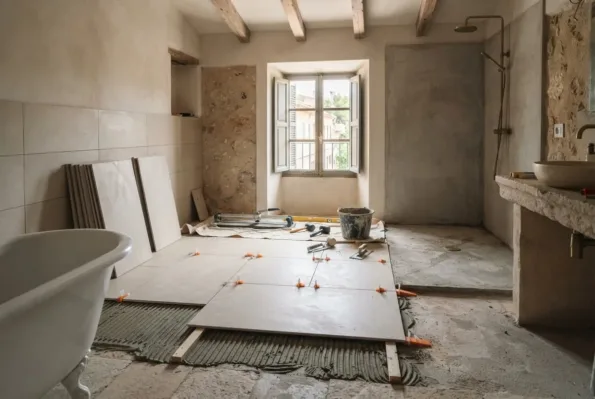
What the tiler needs the wall to be
A tile is only as flat as what it is stuck to. Small ceramic tiles forgive a wall that is slightly out; large-format porcelain does not, and a slab laid on an uneven wall shows every lip at every joint the moment the light comes across it. Natural stone is heavier than either and wants a substrate that will carry it, and microcement wants a substrate that will not move, because a crack underneath becomes a crack on top.
So the tiling job starts before the tiles: the old surface off, the wall or floor made true, a suitable board or render where the substrate is not, and in the wet area the waterproofing under everything. A company quoting for tiling that does not mention the substrate has quoted for the last week of the job.
Then the laying itself: the adhesive suited to the material and the room, the joint width, the grout, the trims at the edges and the corners, the sealing where tile meets bath, tray or glass, and the cuts around every fitting. The difference between a good tiler and an ordinary one is visible for as long as the bathroom lasts.
What a tiling request usually covers
- The old tiles, stone or finish removed
- The substrate made true, and boarded or rendered where it needs to be
- Waterproofing in the wet area, under the tiling
- Floor tiling, with a fall where the floor is a shower
- Wall tiling, to the height agreed – the shower to the ceiling, the rest to a datum
- Large-format handling, where the slabs need two people and a lift
- Trims, edges, corners and the cuts around fixtures
- Grouting and sealing, in a grout suited to a wet room
- Making good where tiling stops and paint begins
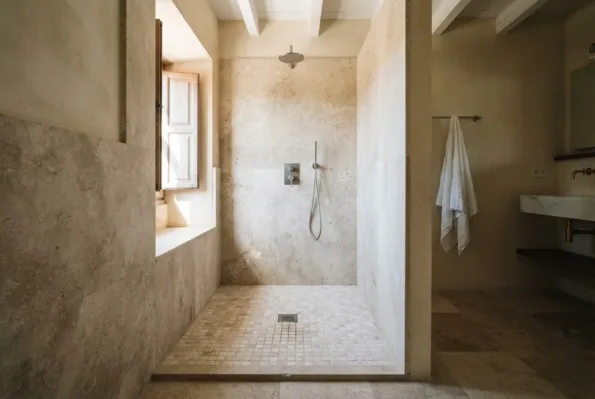
Floors, walls, and the shower floor
The three surfaces in a bathroom do different jobs. A wall tile has to look right and stay put. A floor tile has to do that and be walked on wet, so its surface finish matters – a polished tile that is beautiful on the wall is a hazard underfoot. The shower floor has the hardest job of all: it slopes, it is always wet, and it is where a large tile becomes a small one, because a fall in four directions cannot be laid in one flat slab.
A common solution is one material in three formats: large slabs on the walls, the same slab on the floor, and the same material cut small or in a mosaic in the shower, so the fall can be formed and the surface grips. Ask for it to be drawn that way; the tiler will know why.
What makes two tiling quotes differ
The ranges live on the cost guide.
- The material – ceramic, porcelain, large format, stone, microcement – and how much of it
- How much preparation the substrate needs
- Whether the waterproofing is included, and which system
- How high the walls are tiled, and whether the ceiling is
- The joint width and the grout – fine joints cost more to lay
- Trims and edge details: metal, mitred, or bullnose
- Access – a slab that has to come up a stair is handled twice
- Whether the fixtures are being removed and refitted around the tiling
How your request reaches a company
Mallorca Bathrooms is a comparison service. A request for bathroom tiling goes to the bathroom renovation companies on our list; they quote the work and carry it out, and any agreement is between you and the company you pick.
-
01
Describe the job
Tell us the property, roughly what you want and where it is. Photographs and a rough plan help, though neither is required.
-
02
We match it
The request goes to companies that work in your area and take on this kind of job at this size.
-
03
They quote you
Each company contacts you directly with its own price, timing and approach. We do not set any of it.
-
04
You compare and choose
Put the quotes side by side and take the one you want, or none of them. Using the site costs you nothing.
Porcelain or ceramic?
Porcelain for floors and wet areas, ceramic where it is a wall and a look. Porcelain is denser and harder, absorbs almost nothing and takes a floor’s wear; ceramic is lighter, easier to cut and often cheaper, and does its best work on a wall that stays vertical.
Are big tiles better?
They look calmer and there is less grout to keep. They need a flatter wall, a tiler who handles them often, and a way up the stair. In a shower floor they cannot form a fall, so the same material is cut smaller there. Bigger is a look, not an upgrade.
Can new tiles go over old ones?
Sometimes, on a sound wall that is not in the wet area, and it is a way of avoiding the strip-out. In a shower it is usually the wrong call, because whatever is behind the old tiles is what will fail, and tiling over it hides the moment it does.
Which grout for a bathroom?
One made for wet rooms, in a colour chosen on purpose – grout is a design decision as much as a technical one. Ask for the joint width and the grout type to be on the quote; both change the look and the price.
Get tiling quotes
Describe the room and the surfaces you want once, and let several companies price the preparation and the laying against the same brief.