

Microcement vs Tiles for a Bathroom: Which, and When
Key takeaways
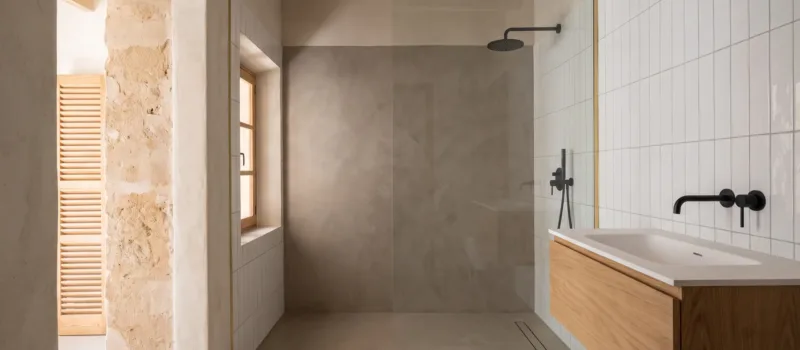
- Microcement: one surface, no grout, a hand-finished look, can go over sound tiles; depends entirely on the substrate and the applicator.
- Tiles: more choice of pattern and grip, made in a factory, replaced one at a time; grout to keep, a grid on the walls.
- Neither keeps a bathroom dry on its own. The waterproofing under them is the same job.
- Many bathrooms use both: microcement on the walls, a tiled shower floor with a fall.
The choice comes up in almost every bathroom renovation on the island now, and it is usually asked as “which is better”. The honest answer is that each is better at different things, in different rooms, for different owners. Here they are side by side.
| Question | Microcement | Tiles |
|---|---|---|
| The look | One continuous surface, hand-finished, reads as plaster or stone | A grid of joints; every pattern, colour and format there is |
| Grout | None | Everywhere, and it has to be kept |
| Repair | A patch is refinished; a damaged wall is a refinishing job | One tile at a time, if you kept spares |
| Grip when wet | A property of the finish and sealer – ask by name | A property of the tile – matt and textured grip, polished does not |
| Over existing tiles | Yes, over sound and well-bonded ones | Sometimes, on a dry wall away from the shower |
| What the wall must be | Sound, stable, dry, primed – it shows every movement underneath | Flat and true, especially for large format |
| Who does it | An applicator, and the applicator is the result | A tiler, and the preparation is the result |
| Small rooms | Makes them feel larger | Large format with fine joints does the same, nearly |
| Old stone houses | Suits the plaster look; wants a dried, dealt-with wall first | Suits the shower; the wall needs making true |
| Waterproofing | Under it, like any finish | Under it, like any finish |
Which room, which owner
A small apartment bathroom that wants to feel bigger, a finca bathroom that wants to read as plaster, an owner who dislikes grout and wants one colour: microcement. A family bathroom that will take knocks, a shower floor that wants visible grip, an owner who wants pattern or the ability to replace one piece: tiles. A master suite at the top of the market: often both, with microcement on the walls and stone or porcelain on the floor where the fall is formed.
What both need
A waterproofed wet area with the fall formed underneath, a substrate that will not move, and somebody who has done this in bathrooms before. The waterproofing page has the questions that apply to either; the microcement and tiling pages are where each becomes a request.
Is microcement cheaper than tiles?
Sometimes, when it goes over sound tiles and saves the strip-out; sometimes not, when the substrate needs preparation and a skilled applicator. The cost guide sets out what moves either; a company that has seen the room prices it.
Can I have microcement walls and a tiled floor?
Yes, and it is one of the most common combinations here: the seamless walls, and a floor that can be cut to a fall and chosen for grip.
This might be interesting to you
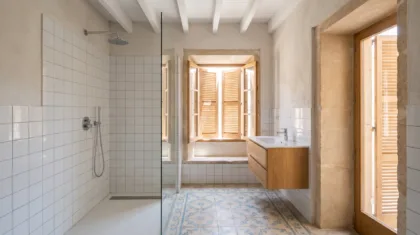
The Best Bathroom Tiles for Mallorca Properties
Porcelain or ceramic, large or small, matt or polished, and why the shower floor is a different ques...
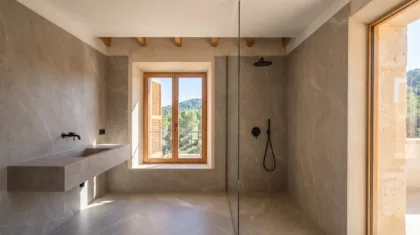
Large-Format Tiles in a Bathroom: Pros and Cons
Fewer joints and calmer walls, at the cost of a flatter wall, a tiler who handles slabs, a way up th...
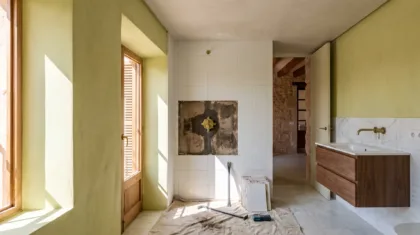
Common Bathroom Renovation Mistakes, and How to Avoid Them
Tiling over the problem, moving the toilet for no reason, a level floor promised before the slab was...
Bathroom Waterproofing Explained
Tiles are not waterproof and grout is not either. What actually keeps a bathroom dry, where it goes,...