

The Best Bathroom Tiles for Mallorca Properties
Key takeaways
- Porcelain for floors and wet areas; ceramic where it is a wall and a look.
- Large format is a look, not an upgrade: fewer joints, a flatter wall, a tiler who handles it.
- The shower floor is cut small so the fall can be formed, whatever the walls are.
- Matt or textured underfoot where it is wet; polished stays on the wall.
The tile is the bathroom you see, and the choice between tiles is a design decision, a budget decision and a technical one at once. This guide is the technical half, written for a bathroom on the island: what each kind of tile does in a wet room, what it asks of the wall behind it, and where the shower floor breaks every rule the walls follow. The tiling page is where it becomes a request.
Porcelain or ceramic
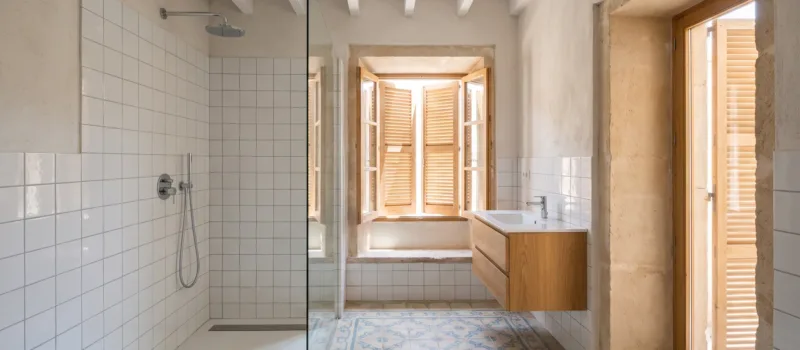
Porcelain is denser and harder, absorbs almost nothing, and takes a floor’s wear and a shower’s water; it is the default for floors and wet areas, and it comes in every finish from stone-look to plain. Ceramic is lighter, easier to cut and often cheaper, with a wide range of designs, and it does its best work on a wall that stays vertical. In a bathroom on the island the usual answer is porcelain on the floor and in the shower, and either on the walls.
Large format, and what it asks for
Big slabs give calm walls with few grout lines and a continuity from floor to wall that reads as one surface. They also need a wall that is flat and true – a slab laid on an uneven wall shows every lip at every joint the moment the light comes across it – a tiler who handles them often, and a way up the stair or along the terrace. In a shower floor they cannot form a fall in four directions, so the same material is cut smaller there. Bigger is a look, not an upgrade.
The shower floor is different
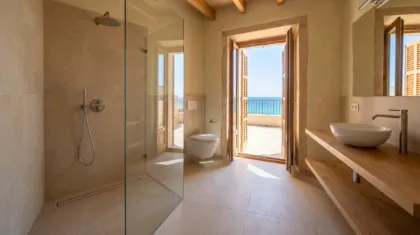
A wall tile has to look right and stay put. A floor tile has to do that and be walked on wet. A shower floor has the hardest job: it slopes, it is always wet, and it is where a large tile becomes a small one. The finish matters more than anywhere else – a polished tile that is beautiful on the wall is a hazard underfoot, and the grip of a tile when wet is a property to ask about by name. A common solution is one material in three formats: slabs on the walls, the same slab on the dry floor, the same material cut small or in a mosaic in the shower.
The wall behind the tile
A tile is only as flat as what it is stuck to, and in an older house the wall is rarely flat: stone under plaster, a partition that has moved, an old tile that sounds hollow. The tiling job starts with the substrate made true, a suitable board or render where it is not, and in the wet area the waterproofing under everything. A quote that names the tiles and not the preparation has priced the last week of the job.
Grout, joints and edges
- A grout made for wet rooms, in a colour chosen on purpose – grout is design as much as technical
- Fine joints look calmer and cost more to lay; ask for the width on the quote
- Trims at edges and corners: metal, mitred or bullnose, decided before the tiles are cut
- Sealant where tile meets tray, bath or glass, and renewed over time
Where a tile is not the answer
Natural stone gives a warmth and a variation no tile has, at the cost of sealing and care; microcement gives one seamless surface with no grout at all, at the cost of depending entirely on the substrate and the applicator. Both have their own pages, and many bathrooms here use tile where the water is and one of the others where it is seen.
Can new tiles go over old ones?
On a sound wall away from the wet area, sometimes, and it avoids the strip-out. In a shower it is usually the wrong call, because whatever is behind the old tiles is what will fail, and tiling over it hides the moment it does.
Which tiles for a small bathroom?
Fewer joints and one material: large format on the walls and floor, cut small only in the shower, in a narrow palette. It is the joints that make a small room feel busy, not the size of the tile itself.
Are stone-look porcelain tiles convincing?
The good ones are, at a distance and underfoot; a sharp eye sees the pattern repeat. They give the look of stone without the sealing and the care, and many bathrooms use real stone on the vanity top and stone-look porcelain where the water is.
This might be interesting to you
Wet Rooms in Mallorca: What to Know Before You Build One
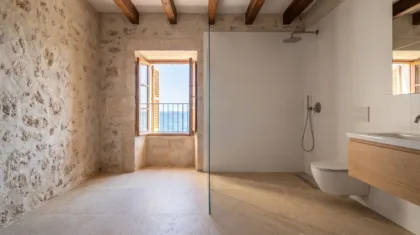
A wet room is the cleanest-looking bathroom there is and the one that most depends on what is under ...
Walk-In Shower or Bath? Deciding, and What the Change Costs
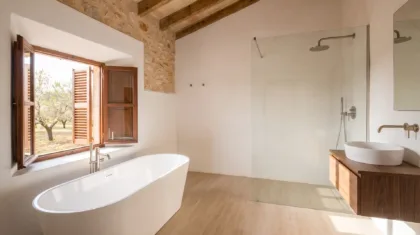
The bath nobody uses against the shower everybody does: when to convert, when to keep one bath in th...
How Long Does a Bathroom Renovation Take in Mallorca?
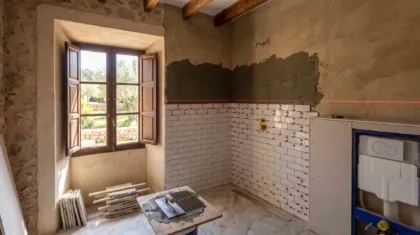
The work in the room, the wait before it, and why the second is often longer than the first on an is...
Hotel Bathroom Refurbishment in Mallorca: Planning a Rollout
The same guest bathroom, twenty or two hundred times, in the window between seasons. The sample room...